
SFO runway guide
SFO has two intersecting runway pairs. In the usual West Plan, aircraft land on 28L and 28R and depart on 01L and 01R.
Open live SFO tracker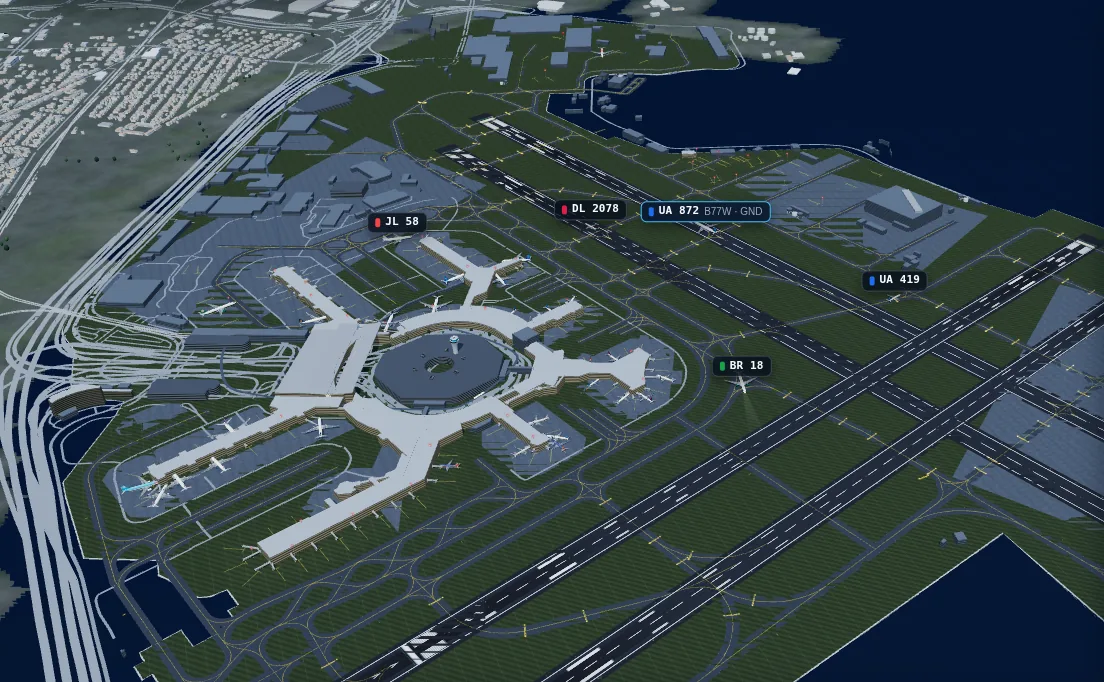
Current SFO runway flow and weather
Estimated flow · West Plan. Arrivals: 28L, 28R. Departures: 01L, 01R.
Based on SFO D-ATIS (Info L) as of .
Weather observation ·
METAR KSFO 260856Z 16003KT 10SM FEW200 13/11 A3025 RMK AO2 SLP243 T01280106 50001 $
What changed at SFO in 2026?
On March 30 the FAA stopped permitting the side-by-side visual approaches familiar to Bay Area observers. In August it introduced staggered parallel landings. Two aircraft can approach the parallel 28 runways with one trailing the other. Seeing two tracks over the Bay does not establish that the aircraft will touch down together.
Runway 1R/19L reopened on September 29 after repaving. That restored pavement used for departures in the West Plan. The reopening and the change to arrival spacing were separate events. For what is happening today, check the timestamp on the flow estimate above.
SFO Airport Commission on the March change (PDF) · FAA’s August procedure, reported by ABC7 · SFO’s reopening announcement · September 29 reopening, with SFO’s spokesperson
What are the runways at SFO?
Each physical runway has a designation at each end. An aircraft approaching 28R flies west toward the same pavement that an eastbound aircraft uses as 10L. The number comes from the magnetic heading rounded to the nearest 10 degrees, with the final zero dropped. L and R indicate left and right from the direction of approach. AirFieldLive writes 1L and 1R with a leading zero to match the format in the FAA airport listing.
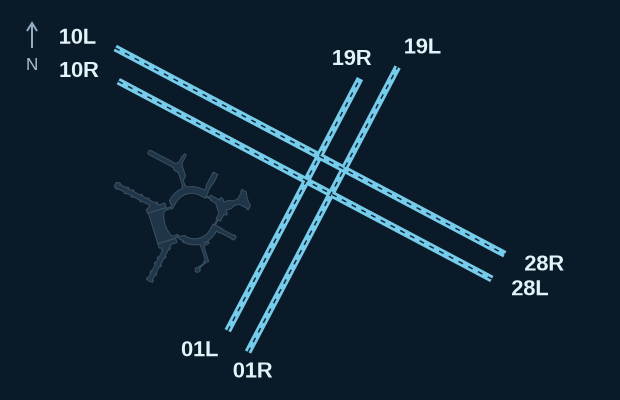
| Runway ends | Length | Width |
|---|---|---|
| 01L / 19R | 7,650 ft | 200 ft |
| 01R / 19L | 8,650 ft | 200 ft |
| 10L / 28R | 11,870 ft | 200 ft |
| 10R / 28L | 11,381 ft | 200 ft |
FAA airport listing for KSFO · FAA runway marking standard · SFO runway map (PDF)
West Plan and Southeast Plan
The West Plan is SFO’s usual runway configuration when winds are from the west or north. With southeasterly winds, the airport can switch to the Southeast Plan, sometimes called reverse flow.
West Plan
- Primary arrivals
- 28L / 28R
- Primary departures
- 01L / 01R
Southeast Plan
- Primary arrivals
- 19L / 19R
- Primary departures
- 10L / 10R
Wind speed and direction are the main factors in runway selection. Visibility, cloud ceiling, aircraft performance, noise procedures, and runway maintenance can also affect which runways controllers use.
SFO runway maps and operating plans · SFO Noise Office on runway selection
Which SFO runways are active now?
Open the live SFO flight tracker and read the Flow indicator. On compact screens, find it under View. ARR shows the estimated arrival runways and DEP shows the estimated departure runways. Select SFO in the toolbar to see the available runway-by-runway details and the basis for the estimate.
AirFieldLive compares nearby aircraft tracks with runway centerlines. When there is little or no traffic on final approach, the estimate can fall back to surface wind or the standard west flow. Use the data methodology to interpret these labels, or the plane spotting guide to find a view of the airfield.